The Complete Guide to Choosing the Right E-Waste Recycling Company in Singapore
Older (yet still capable) consumer electronics are either stored unused, passed to family members, or, if the older device is really inconvenient to use, just thrown away.
However, improper disposal of electronic waste has a significant environmental impact due to hazardous chemicals and metals. They also pose a security risk to their previous owners, as these devices contain sensitive data and, if lost, could be found and accessed by thieving hands.
Choosing the right e-waste recycling company in Singapore ensures that discarded electronics are handled safely, valuable materials are recovered, and responsible recycling practices are followed. By partnering with a licensed e-waste recycler like Vision Green, businesses and individuals can help build a more sustainable future and reduce e-waste in landfills.
Key Takeaways
- Secure Data Handling is Critical: Partnering with a licensed e-waste recycler ensures all sensitive information on devices is permanently erased or destroyed. This protects individuals, businesses, and institutions from potential data breaches and identity theft.
- Environmental Responsibility Matters: Proper recycling prevents hazardous chemicals and metals from contaminating the environment. E-waste recyclers recover valuable materials and promote a circular economy, reducing reliance on virgin resources.
- Choose Certified and Licensed Providers: Look for recyclers certified by NEA, SERI (R2), and audited against ISO standards. Certifications confirm compliance with safety, environmental, and quality standards, ensuring responsible and professional service.
- Scalable Solutions for Different Needs: Whether it’s a single household device or bulk e-waste from offices, schools, or hospitals, recyclers can handle various volumes. Proper scale ensures timely disposal, maximum material recovery, and data security.
- Transparency and Reporting Build Trust: Reliable recyclers provide detailed documentation and certificates of destruction. This creates accountability, allows for regulatory compliance, and assures clients that electronics were processed safely and responsibly.
Responsibilities of an E-Waste Recycling Company
An effective e-waste recycling company has a responsibility to both their clients and the environment. They should offer a quality of service that protects consumers' data and fosters a green initiative.
- Maintain data privacy: All devices containing sensitive information, such as computers, mobile phones, and storage systems, must undergo secure data destruction. This helps prevent data breaches and identity theft, ensuring the device owner's safety and security.
- Ensure safe dismantling and disposal: Proper handling of e-waste prevents hazardous materials from entering the environment. Devices such as phones and laptops contain metals and flammable materials that, if improperly disposed of, can pose a safety risk. Recyclers use controlled disposal processes to prevent safety hazards while maximising the yield from recycling equipment.
- Refurbish usable electronics: Functional devices can be refurbished for reuse, minimising the need to produce new electronics, which can contribute to increased mining and emissions.
- Minimise environmental impact for its clients: A recycler should operate in accordance with its clients' green thumb initiatives. Clients approach recyclers to reduce their carbon footprint. As such, these facilities have a moral, environmental obligation to uphold for their clients.
- Reuse and recycle metals found in electronics: Recovering metals, plastics, and other materials supports resource recovery and helps maintain a circular economy.
It's imperative that the e-waste solutions provider in Singapore that we partner with shares our green sentiments. Recyclers with that social drive won’t lag in service quality. This is essential to fostering a more sustainable economy.
Who Needs an E-Waste Solutions Provider in Singapore

With technology in every nook and cranny of our everyday lives, our day-to-day comes to a halt without it. As such, technology is ingrained in plenty of organisations' operations.
Those needing to get in touch with an e-waste service include:
- Offices: Companies frequently replace computers, laptops, and data-storing devices, creating e-waste when not recycled. Partnering with a recycler ensures proper handling and data security for all discarded devices.
- Schools: Educational institutions upgrade ICT equipment regularly to provide relevant, up-to-date ICT education. This is especially true for engineering and computer science departments at universities. As such, e-waste recycling may be needed, as the old devices may contain student projects, records, faculty data, and administrative files that would need to be wiped.
- Government agencies: Agencies deal with sensitive information, often involving city or state projects and confidential data. Working with certified recyclers ensures secure data destruction that can't be recovered. Leaks from these agencies can result in potential security threats.
- Retailers with Obsolete Stock: The Extended Producer Responsibility (EPR) Scheme under the Resource Sustainability Act makes producers, importers, and retailers legally responsible for the end-of-life collection and recycling of electronics. This is outlined in Section 14 and 15 of the Resource Sustainability Act of 2019. Partnering with a recycler ensures compliance with this scheme while safely disposing of obsolete stock.
- IT Facilities and Data Centres: These facilities house devices that store sensitive customer data, such as names, addresses, and payment information. Certified recyclers provide asset disposition and data destruction services to prevent breaches.
- Hospitals: Medical facilities contain electronic equipment with confidential patient information. Proper recycling protects patient information and prevents potential breaches to sensitive patient data.
What to Look for in an E-Waste Recycling Company in Singapore
As with many facilities, not all e-waste recycling companies operate with the same level of efficiency. Some may be more robust than others. Factors to look out for before partnering with an e-waste recycling company include:
Green Initiatives
An e-waste recycler's green drive should be as robust as their services. Look through their 'About Us' section and their previous projects to see the kind of change they've made for the environment.
A well-principled recycling plant is driven by its environmental and social responsibility, not just by profit. This drive will be evident in the quality of service they provide and the compliance they adhere to. These kinds of facilities are those that individuals and companies should work with, especially those looking to reduce their carbon footprint.
Transparency and Reporting
Reliable recyclers maintain complete records of collection, dismantling, and material recovery. Trust is key in any partnership, especially when the client aims to make a sustainable impact through their partnership with the recycling facility.
Look for facilities that are open for consultation. They'll be transparent about their procedures and explain how their process works.
After recycling, these facilities also provide information on the quantities of items smelted and those refurbished for resale.
Transparent recycling facilities will provide a certificate of destruction, confirming that items requested for smelting have been successfully converted into raw materials (e.g., metals, plastics). This gives clients assurance that their electronics were handled responsibly and recycled properly.
Utilisation of Discarded Components
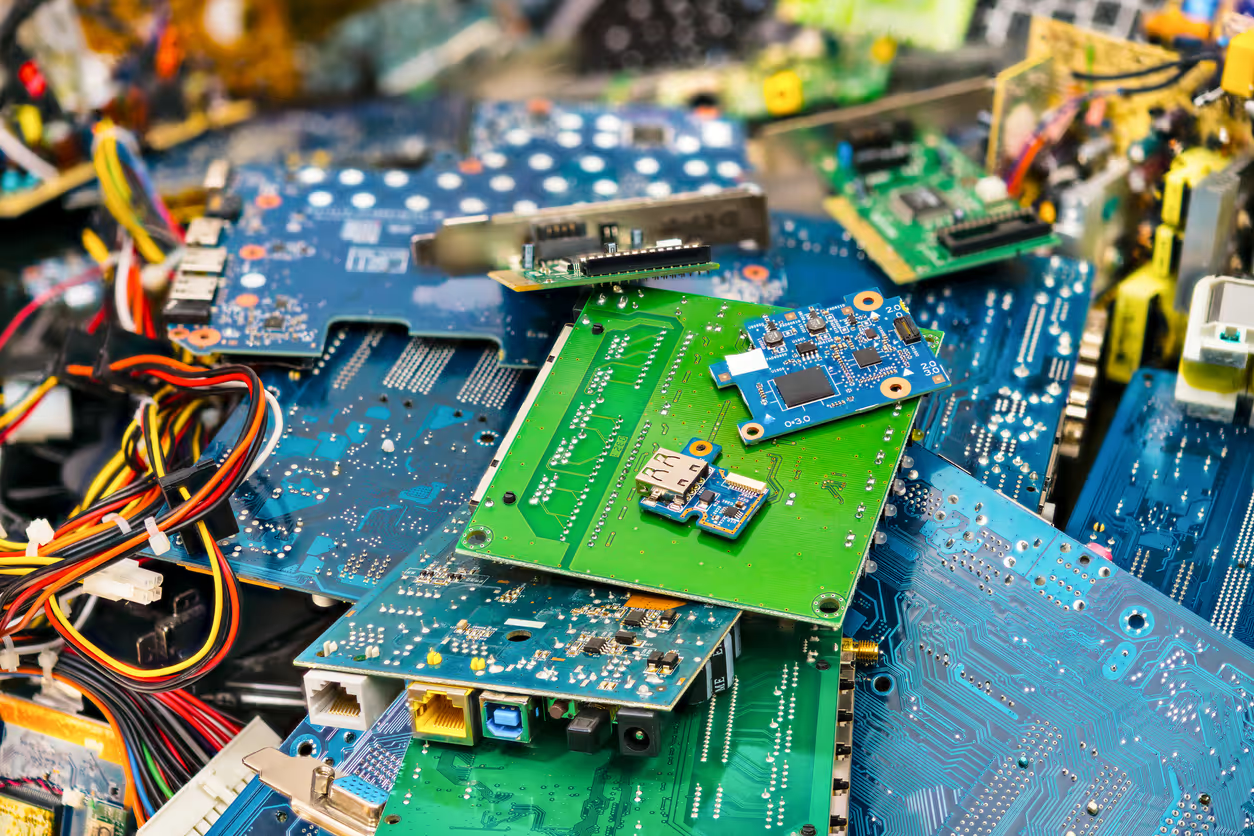
The more recyclers can extract from discarded e-waste, the better.
E-waste can be a coconut tree yield if recyclers are thorough. This results in more materials and components making their way back into a circular, sustainable economy. Materials that can be extracted from phones, laptops, and other electronics include the following:
- Raw materials. The most fundamental building blocks of these electronics. Metals, such as gold, silver, aluminium, and copper can be harvested from devices in order to be used in making new electronics.
- Circuitry boards. Printed circuit boards (PCBs) can be reused to make newer or makeshift electronics. They can also be provided to schools and learning institutions for electronics and engineering vocational. Fried circuit boards can still be dismantled to recover valuable components such as capacitors, resistors, and connectors. These recovered elements can either be reused in repairs or sent for further recycling.
- Gadget components. Parts such as fans, heat sinks, casings, and memory devices can be salvaged from devices. Acquiring these components makes repair services more affordable, making holding onto devices a more practical option for both consumers and businesses.
- Sensors. Many devices contain optical, motion, or temperature sensors that can be extracted. These sensors can be refurbished for industrial, scientific, or educational applications.
- Semiconductors. CPUs, GPUs, memory chips, and other integrated circuits can sometimes be tested and reused. With a skilled repair shop, they can find new life in a new device. Even if they are nonfunctional, valuable metals and connectors inside can still be reclaimed.
- Batteries. Rechargeable batteries, like lithium-ion cells, will still have a good deal of juice in them. They can be used for other electronics' power supplies. They can also be extracted of lithium, cobalt, and aluminium.
Leading recyclers harvest maximise their yield.
Also, licensed e-waste recyclers have to meet a recovery weight when processing a given amount of e-waste, as outlined in Section 3 of the E-waste Recyclers Regulations of 2021. Remember, recycling still consumes energy. As such, it’s only proper that an e-waste recycler be efficient.
Certified and Licensed
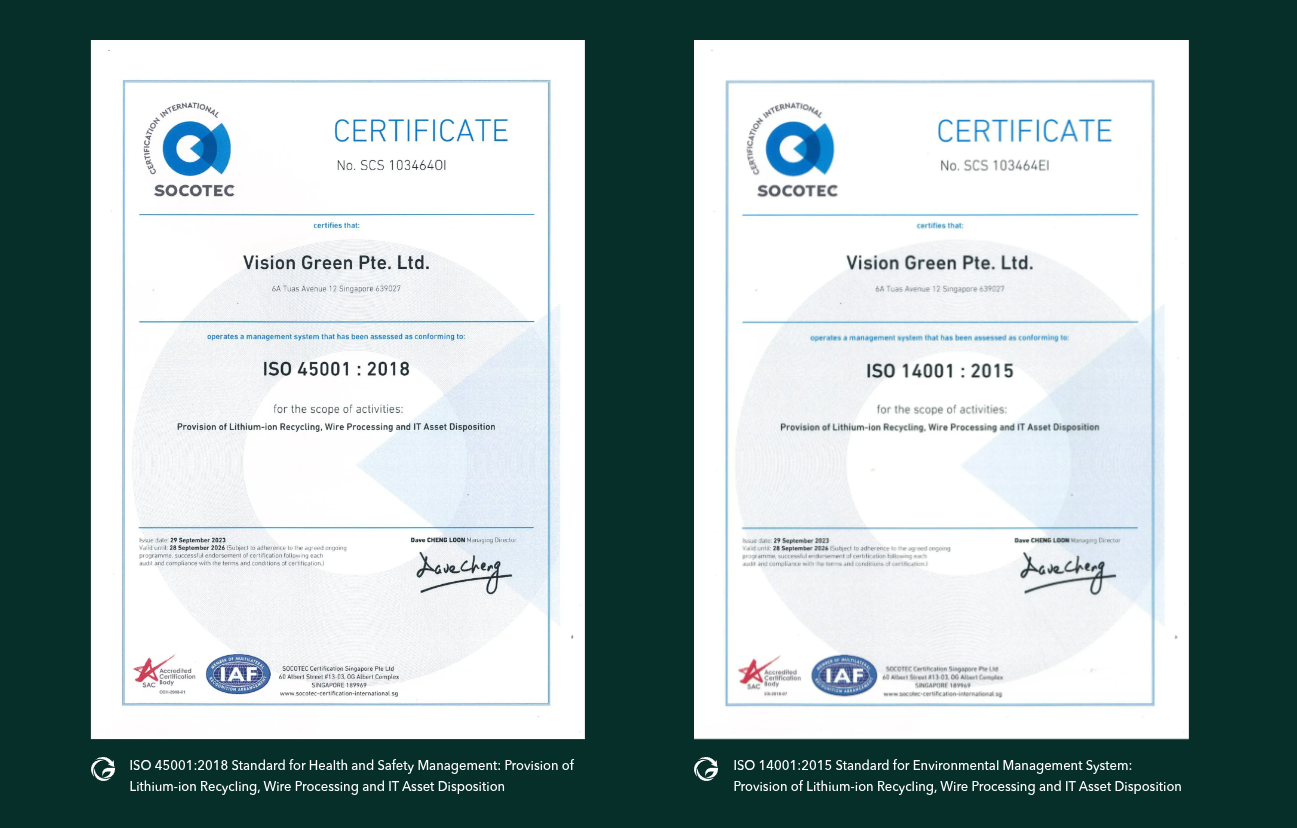
Certifications and licenses are recognitions provided by third-party bodies, recognising a facility for their sustainable and environment-centered operations.
The ideal e-waste recycling facility will have certificates on operational efficiency, worker safety, and environmental safety. These can be encompassed by the following certifications:
- SERI - The Sustainable Electronics Reuse and Recycling (R2 standard) is managed by the Sustainable Electronics Recycling International (SERI). The R2 standard is a globally recognised voluntary standard for responsible electronics reuse, refurbishment, and recycling. This certificate is awarded to e-waste recycling facilities that uphold data sanitisation, environmental and health safety, and transparency of operations.
- NEA Licensed - Certification from the National Environment Agency (NEA) ensures the recycler meets environmental regulations and standards for safe handling of hazardous materials. NEA-certified recyclers comply with the Environmental Public Health Act of 1987, guaranteeing safe e-waste management for both human and environmental health.
- SOCOTEC - SOCOTEC sees to it that a certified company follows ISO standards. These ISO certifications are awarded to facilities that maintain quality control and safe operational procedures in their day-to-day operations. Here at Vision Green, we possess the ISO 45001:2018 (Occupational Health & Safety Management Systems), the ISO 14001:2015 (Environmental Management Systems), and the ISO 9001:2015 (Quality Management Systems).
Recycling Scale
Individuals, households, and consumers can dispose of their old electronics at small-scale recycling facilities or repair centres that buy electronics for parts.
However, for offices, agencies, schools, and other organisations with a larger volume of e-waste, they should opt for larger-scale recycling facilities — those equipped to process e-waste in bulk. Assess your inventory of e-waste and see if the facility has the capacity to handle the load.
This ensures that the pile of laptops and computers are quickly disposed of. The sooner, the better, especially if sensitive data is involved.
Requirements to be a Licensed E-Waste Recycler
The requirements to be a licensed e-waste recycler, according to the Resource Sustainability (E-Waste Recyclers) Regulation 2021, include the following:
- The recycler should meet the material recovery target. This means that for a given weight of e-waste, the recycler should meet a target weight of recovered materials (Section 3). Meeting this target means a recycler is thorough with their harvesting processes and maximises their yield.
- The recycler removes all specified pollutants from any electrical or electronic product (Section 4a). Hazardous substances such as batteries, plastics, and heavy metals are extracted to prevent environmental contamination.
- The recycler processes or treats the removed pollutants so that they don't harm the environment (Section 4b). Materials are handled using certified treatment processes.
- Ensures that all data stored in a data‑bearing device that the licensed e‑waste recycler received for disposal is permanently erased or destroyed (Section 6). This step guarantees data security, protecting businesses and individuals from data breaches and theft.
- Keeps records and reports on their recycling flow for transparency. E-Waste recyclers are required to keep and maintain this record for five years since the record was produced (Section 8).
These regulations not only preserve the environment but also ensure that the e-waste recycler acts in the moral and environmental interests of its clients.
How to Partner with an E-Waste Recycling Company

Partnering with a certified recycler involves a clear, step-by-step process:
- Step 1: Assess your electronic waste inventory - Identify all devices, ICT equipment, and bulky e-waste for disposal.
- Step 2: Select a certified recycling partner - Ensure they are NEA-certified and capable of responsible recycling.
- Step 3: Schedule collection or drop-off - Recyclers provide safe transport to prevent contamination or damage.
- Step 4: Receive reporting and certificates - Clients receive a certificate of destruction confirming secure data destruction and compliance with environmental regulations, providing peace of mind and documentation for audits.
This ensures compliance with local regulations, minimises environmental impact, and supports a greener future.
How is E-Waste Recycled Securely and Efficiently
After partnering with an E-waste recycling company, E-waste goes through the following steps:
- Step 1: Weighing and Recording - Each item is logged for accountability, forming a detailed inventory of electronic devices for reporting purposes.
- Step 2: Sorting and Segregation - Devices are sorted into categories: computers, mobile phones, batteries, plastics, metals, and bulky electronics. This improves recycling efficiency and resource recovery.
- Step 3: Dismantling and Material Recovery - Components are carefully dismantled. Precious metals, rare earth metals, and plastics are extracted to be recycled responsibly, reducing virgin resource demand.
- Step 4: Refurbishing - Functional electronics are refurbished for resale or donation, extending the life cycle and promoting a circular economy.
Proper e-waste recycling safeguards your data, reduces environmental impact, and recovers valuable materials. Partner with Vision Green, Singapore’s trusted licensed e-waste recycler, for comprehensive services, from asset disposition and battery recycling to secure data destruction and ICT equipment handling.
Take action today to dispose responsibly, support a sustainable future, and contribute to a more sustainable Singapore while ensuring your business or household complies with local regulations.
Recycle Old Devices with an E-waste Recycling Company in Singapore Today!
As technology advances, electronic devices and equipment quickly become obsolete, with tech companies unveiling the "brand new" model every turn of the calendar. From computers and mobile phones to small household appliances and ICT equipment, these devices accumulate in homes, offices, schools, and hospitals.
Because of this yearly innovation, Singapore also incurs e-waste.
Partner with Vision Green today and join the green initiative. Instead of throwing away unused devices, we process them for recycling. That way, we minimise the impacts of mining for raw materials and make owning electronics more accessible.
Frequently Asked Questions (FAQs)
Can e-waste recyclers refurbish devices for donation to schools or NGOs?
Yes, functional devices can be refurbished and redistributed to educational or charitable organisations. All sensitive data is securely wiped before refurbishment to ensure privacy.
Are there specific e-waste categories that must be processed differently?
Yes, items like batteries, storage devices, networking equipment, and medical electronics often require different handling methods from each other. Different recycling methods are used depending on the materials and potential hazards for each component.
How can clients verify the authenticity of destruction or recycling certificates?
Licensed recyclers provide detailed certificates with device information, methods used, and compliance references. Clients can cross-check with the recycler and, if needed, regulatory bodies for verification.
What are the common mistakes organisations make when choosing a recycler?
Relying on unlicensed providers, failing to verify certifications, or failing to assess the recycler’s legitimacy can compromise data security. Always choose certified providers.
What happens to non-functional electronics that cannot be refurbished?
Devices that cannot be reused are dismantled, and valuable materials such as metals and plastics are recovered. The remaining parts are disposed of safely in accordance with environmental regulations.